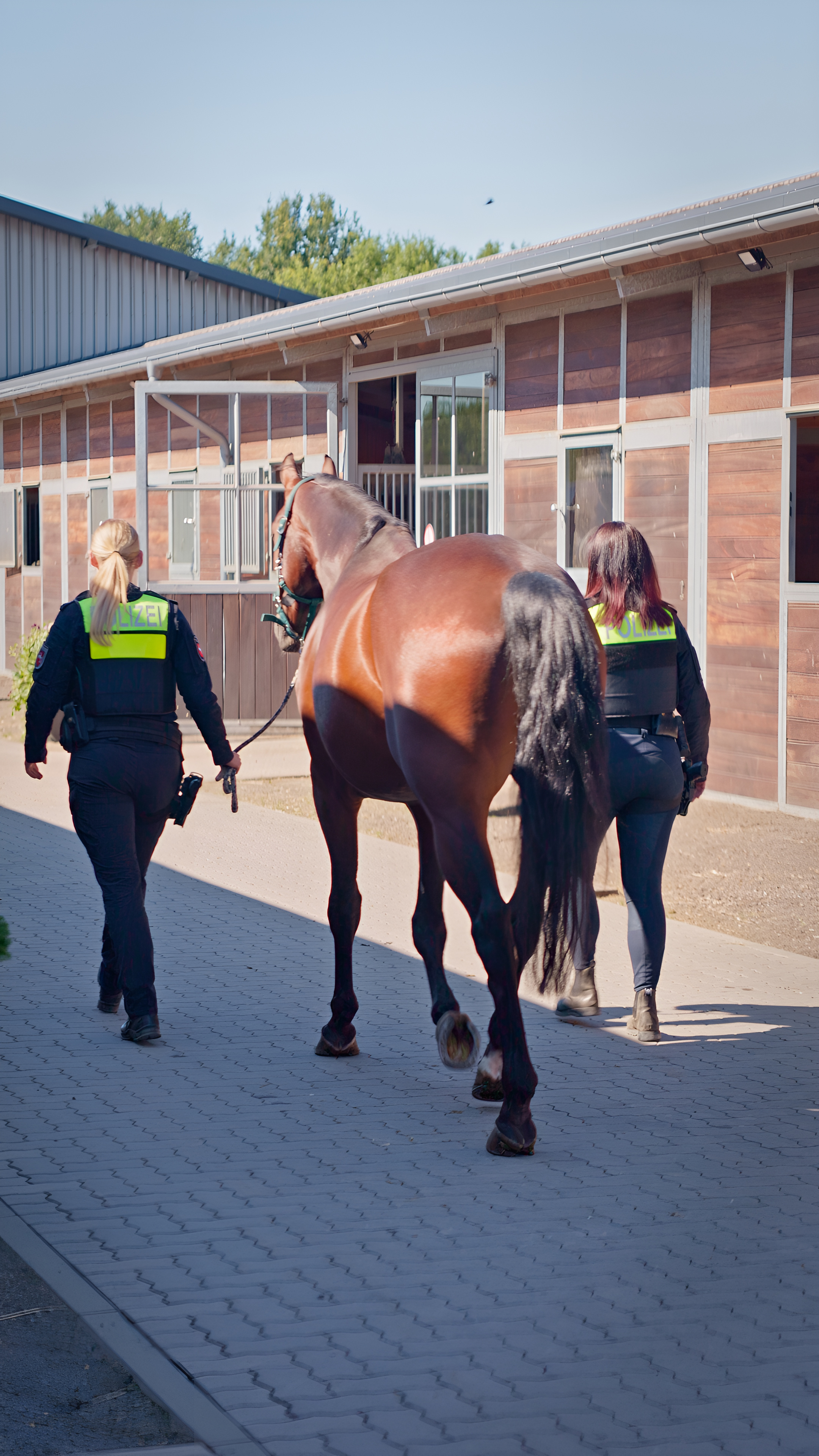
Does your horse show neurological abnormalities such as unsteadiness, swaying or stumbling, or does it have rideability problems such as difficulty with flexion or resistance?
Is the neck the problem?
Several scientific studies show that about 30 percent of warmblood horses have anatomical changes in the rear (caudal) cervical vertebrae. These variations may be linked to symptoms such as movement problems, pain or even the inability to carry a rider.
Unfortunately, the studies so far do not allow this link to be established beyond doubt. The heritability of the anatomical variations of the caudal cervical vertebrae has not been studied yet either.
We therefore invite you to take part in the EQUCAP research project:
“Studies on the clinical significance and heritability of congenital anatomical changes in the caudal cervical and cranial thoracic vertebrae of warmblood horses”
By having your horse examined as part of this study, you make an important contribution to warmblood breeding, and you also receive a detailed report on your horse's current state of health.
Please fill in the registration form and send it to us by email at mail@hanseklinik.com. We will then let you know whether your horse is eligible for the study.

Studies on the clinical significance and heritability of congenital anatomical changes in the lower cervical and first thoracic vertebrae of warmblood horses
In recent years, several studies have shown that around 30% of warmblood horses can have anatomical changes in the lower (caudal) cervical vertebrae (references 1, 2, 3, 4, 5, 6, 7, 8). From a medical and an animal welfare point of view, it would be important to know how common these changes are in warmblood horses in Germany, whether they may be heritable, and whether they lead to movement disorders, pain or even the inability to carry a rider (unrideability). Most of the studies so far do not allow this link to be established beyond doubt, because they are based on data that were not collected specifically for this question (references 2, 4, 5, 6, 8). In addition, the control horses were not comparable with the respective case group in age, medical history, pedigree and level of training. A very recent study, designed specifically to answer whether the anatomical variations of the lower cervical and first thoracic vertebrae affect the health of horses, rejects the link (7). The horses in that study were warmbloods from England and the USA. Heritability of the anatomical variations is assumed but has not been studied yet.
The aim of this project is therefore to study anatomical changes in the caudal cervical spine and the first thoracic vertebrae (including their ribs) with regard to their frequency (prevalence) and heritability, as well as their effects on the well-being of the affected animals.
To obtain meaningful results, the participating horses are first assigned to a case group or a control group and then examined clinically, orthopedically, neurologically and with imaging (in particular radiography). The study design comprises two groups of about 250 horses each. The first group (case group) includes animals with clinical signs of a coordination disorder but without lameness or pain at the junction of the cervical and thoracic spine. The second group (control group) includes horses without these symptoms. To keep the animals examined as homogeneous as possible, only closely related warmblood breeds (Hanoverian, Westphalian, Oldenburg, Holsteiner) and only animals aged 3–16 years are included in the study. Each of these two groups is then divided into two further groups according to whether anatomical changes of the lower cervical and first thoracic vertebrae are present. In total, there are therefore 4 groups of horses: 1) with symptoms and with changes, 2) with symptoms and without changes, 3) without symptoms and with changes and 4) without symptoms and without changes.
The effects on health and well-being are assessed through pain sensitivity in the withers region and through impairment of the horses' balance, rideability or movement patterns. Modern digital radiography equipment and methods are used, as well as computed tomography (at some of the participating clinics). Heritability is examined using genomic data. These allow family relationships to be mapped very precisely and, at the same time, trait loci with a significant influence on the anatomical changes in the lower cervical spine to be narrowed down. By having your horse examined, you receive a detailed report on the current condition of the areas relevant to the study.
We would be very glad if you allowed us to include your horse in the study!
References are available on request: 1 May-Davis, 2014; 2 DeRouen et al., 2016; 3 Veraa et al., 2016; 4 Beccatti et al., 2020; 5 Crijns and Broeckx, 2020; 6 Veraa et al., 2020; 7 Dyson et al., 2024 b; 8 Henderson et al., 2024
Further information is available at: pferdeforschung-halswirbel.de/


We kindly ask you to schedule appointments by phone. This way, we can plan the best treatment for your horse individually and directly.
+49 4282 - 5946 340Please note our separate visiting hours.
Please schedule your visit in advance. Allow approximately 1 hour, and kindly only touch your own horse.
Our clinic is available around the clock for emergencies.In case of an emergency, please call us immediately.