Equine Recurrent Uveitis (ERU) is one of the most significant eye diseases in horses. It is very common and remains the leading cause of blindness in horses worldwide. The condition is still widely known as periodic ophthalmia because the classic form is characterized by recurring, painful episodes of intraocular inflammation. These painful flare ups are often followed by phases in which the eye appears quiet and non painful.
Despite these symptom free intervals, repeated inflammation inside the eye causes progressive and irreversible damage. Over time, this can lead to loss of vision and in severe cases to complete loss of the eye.
In approximately 25 to 30 percent of affected horses, both eyes are involved. ERU is not contagious and cannot be transmitted from one horse to another. It therefore poses no risk to neighboring horses.
ERU can have multiple contributing factors. Genetic predisposition and the individual immune response of the horse play an important role.
Research has shown that leptospires are a major triggering factor. These bacteria are commonly present in stables and on pastures. They are most often introduced through rodent urine contaminating feed, water or bedding.
When leptospires enter the horse’s body, they are usually eliminated by the immune system and cause no harm. If the immune response is insufficient, however, the bacteria can reach the interior of the eye and settle in the vitreous body. Once inside the eye, leptospires multiply until the first inflammatory episode occurs.
During this acute phase, inflammatory byproducts develop that can no longer be removed from the vitreous body. Both the bacteria and these inflammatory substances cause clouding within the eye and damage delicate ocular structures. They also act as persistent triggers for further inflammatory episodes.

When inflammation primarily affects the posterior part of the eye, the disease may cause little pain. In these cases, external signs of eye disease are often subtle or absent. Owners may instead notice increased spookiness or behavioral changes, particularly as vision becomes impaired over time.
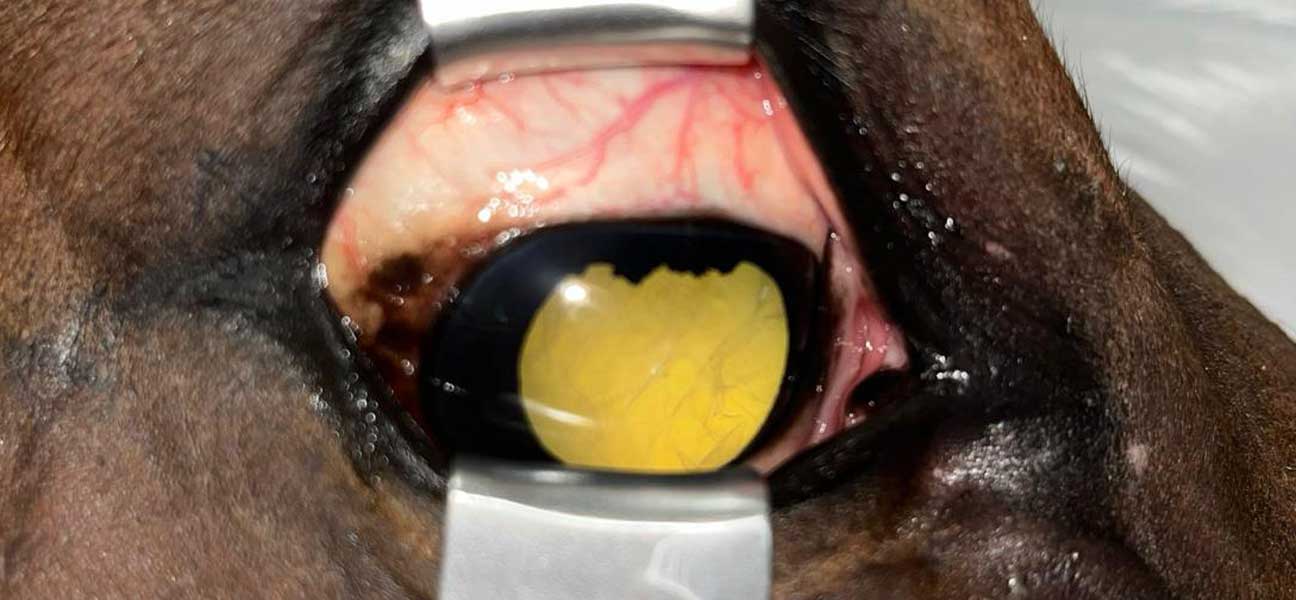
More commonly, inflammation affects the anterior part of the eye, which contains many nerve endings. In these cases, pain is significant and clearly visible. Horses may squint, show excessive tearing and react strongly to light. On closer examination, the cornea often appears cloudy and the pupil constricted. In some cases, fibrin, blood or inflammatory cells may be visible in the anterior chamber of the eye.

Dieses Pferd zeigt einen vermehrten Tränenfluss aufgrund einer periodischen Augenentzündung.

Lidkneifen ist eines der Symptome der Equinen rezidivierenden Uveitis.

Dieses Pferd hat Blut in der vorderen Augenkammer.
Repeated inflammatory episodes or a slowly progressing chronic inflammation cause increasing damage to the internal structures of the eye. Inflammatory deposits attach to the lens, leading to adhesions between the back of the iris and the front surface of the lens, known as synechiae.
As a result, the lens becomes opaque and cataracts develop. These adhesions also deform the pupil, preventing it from functioning normally. Inflammatory material causes clouding of the aqueous humor and vitreous body. Reduced production of aqueous humor leads to decreased intraocular pressure, and the eye gradually shrinks.
In advanced stages, retinal detachment occurs, ultimately resulting in blindness.
A thorough ophthalmic examination is essential to establish an accurate diagnosis and initiate appropriate treatment as early as possible. The examination begins with a detailed medical history, as owners often provide valuable information about previous episodes and symptoms.
After assessing reflexes and vision, the individual structures of the eye are examined systematically. Optimal examination conditions are crucial, including a calm environment and the ability to darken the room. The anterior segments of the eye are examined using focused light and magnification with a head loupe or magnifying glasses. A handheld slit lamp is a highly valuable tool in equine ophthalmology. The posterior segments are then evaluated using an ophthalmoscope.
Additional diagnostics may be required in certain cases. Measurement of intraocular pressure provides further insight. Ultrasound examination is particularly important when the pupil is constricted due to pain or when the anterior segments are too opaque to visualize the interior of the eye.
If leptospiral infection is suspected, a small sample of aqueous humor may be carefully collected from the anterior chamber and analyzed in a specialized laboratory. In cases where retinal function is uncertain, electroretinography (ERG) is indicated. This test measures retinal responses triggered by light stimuli.
Acute inflammatory episodes must be treated as quickly as possible to relieve pain and minimize permanent damage. Treatment includes intensive local therapy with ophthalmic ointments and atropine eye drops. Systemic anti inflammatory medication is also administered.
To prevent further episodes, a highly effective surgical technique was developed between 1989 and 1991 by Professor Gerhards in collaboration with human ophthalmologist Professor Werry. This procedure, known as vitrectomy, involves removing the infected vitreous body through an intraocular operation. Bacteria, inflammatory debris and opacities are flushed out, while the vitreous cavity is simultaneously filled with a specialized fluid closely resembling natural aqueous humor.
At the Hanseklinik für Pferde, this procedure is performed more than 1,000 times per year and is considered routine by our ophthalmology specialists.
ERU does not resolve on its own. However, minimally invasive vitrectomy allows permanent control of the disease in approximately 96 to 98 percent of cases, effectively preventing further painful inflammatory episodes.
No. ERU is not transmitted from horse to horse, and affected horses do not need to be isolated.
Unfortunately, there is no proven way to prevent ERU. If the disease occurs, early and intensive treatment is essential to relieve pain and prevent irreversible damage.
The goal should always be to stop the disease. ERU is usually painful, and timely, targeted treatment can prevent blindness and significantly improve quality of life.
Equine Recurrent Uveitis (ERU) is one of the most significant eye diseases in horses. It is very common and remains the leading cause of blindness in horses worldwide. The condition is still widely known as periodic ophthalmia because the classic form is characterized by recurring, painful episodes of intraocular inflammation. These painful flare ups are often followed by phases in which the eye appears quiet and non painful.
Despite these symptom free intervals, repeated inflammation inside the eye causes progressive and irreversible damage. Over time, this can lead to loss of vision and in severe cases to complete loss of the eye.
In approximately 25 to 30 percent of affected horses, both eyes are involved. ERU is not contagious and cannot be transmitted from one horse to another. It therefore poses no risk to neighboring horses.
No. ERU is not transmitted from horse to horse, and affected horses do not need to be isolated.
Unfortunately, there is no proven way to prevent ERU. If the disease occurs, early and intensive treatment is essential to relieve pain and prevent irreversible damage.
The goal should always be to stop the disease. ERU is usually painful, and timely, targeted treatment can prevent blindness and significantly improve quality of life.
We kindly ask you to schedule appointments by phone. This way, we can plan the best treatment for your horse individually and directly.
+49 4282 - 5946340Please note our separate visiting hours.
Bitte vereinbaren Sie einen Besuchstermin im Voraus. Planen Sie etwa 1 Stunde ein und berühre bitte nur dein eigenes Pferd.
Our clinic is available around the clock for emergencies.In case of an emergency, please call us immediately.

We kindly ask you to schedule appointments by phone. This way, we can plan the best treatment for your horse individually and directly.
+49 4282 - 5946 340Please note our separate visiting hours.
Please schedule your visit in advance. Allow approximately 1 hour, and kindly only touch your own horse.
Our clinic is available around the clock for emergencies.In case of an emergency, please call us immediately.

We kindly ask you to schedule appointments by phone. This way, we can plan the best treatment for your horse individually and directly.
+49 4282 - 5946 340Please note our separate visiting hours.
Bitte vereinbare einen Besuchstermin im Voraus. Plane etwa 1 Stunde ein und berühre bitte nur dein eigenes Pferd.
Our clinic is available around the clock for emergencies.In case of an emergency, please call us immediately.