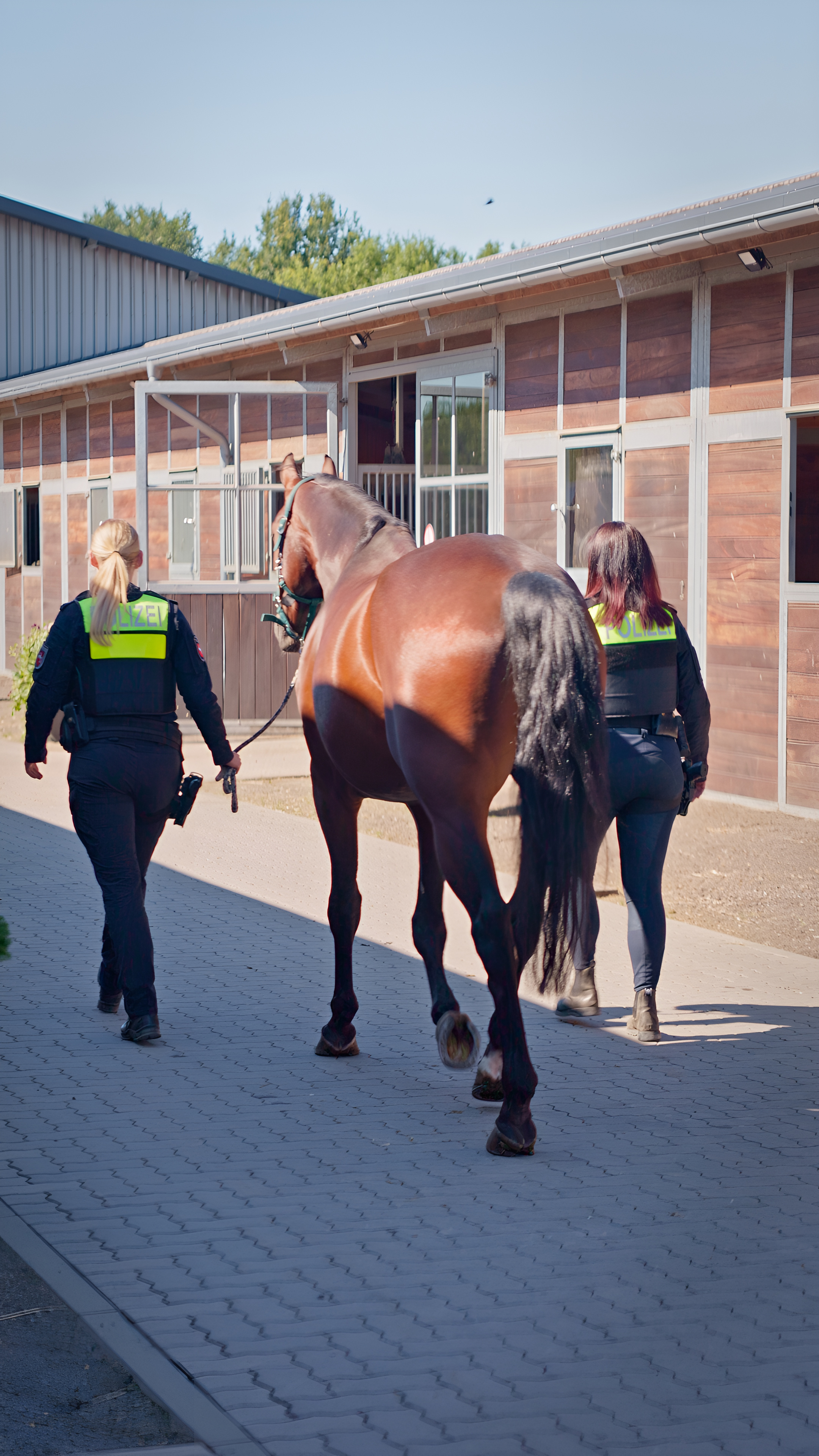
Curious, calm and with the Braunschweig mounted police unit for four years: the eight-year-old gelding Rabauke is a service horse you can rely on. When recurring eye inflammation became more and more of a problem and ointments and eye drops brought no lasting improvement, he was presented at the Hanseklinik für Pferde.
Dr. Kirstin Brandt, lead senior clinician in the ophthalmology department, diagnosed recurrent uveitis. The disease, also known as periodic ophthalmia, causes recurring, painful flare-ups of inflammation and can lead to blindness in the long term. After a thorough examination, the decision was made to treat it surgically. “Rabauke came to us at exactly the right time. Despite the previous inflammation, no severe permanent damage had occurred yet. Those were very good conditions for the treatment,” explains Dr. Brandt. “With diseases like this, we look at each horse very closely and decide individually which approach is medically right.”
Two vitrectomies followed, performed at different times. In this procedure, part of the vitreous body inside the eye is removed and replaced with a clear fluid. The left eye was operated on first, then the right. Both procedures went without complications, and there were no problems with the anesthesia either. At the final examination, the Hanseklinik also checked the function of the retina. The findings were normal.
“We are very satisfied with what the final examinations showed,” says Dr. Brandt. “If nothing unforeseen happens now, there is a very good chance that he will keep his full vision and that the eye inflammation will not return. That is especially important to us, because our first priority is that the horse is free of pain in the long term.”
After the second operation, Rabauke can take things easy at first. Seven more days of box rest and controlled exercise at the walk allow the sutures on the eye to heal undisturbed. He also receives eye drops. Because the atropine used keeps his pupils dilated for several more weeks and makes him more sensitive to light, he temporarily wears a well-fitting fly mask outdoors.
After that, he can gradually be brought back into training. How quickly this happens depends on how he heals. “Our horses are with us for many years and are an important part of our daily work. For us, it goes without saying that we look closely and act early when we notice a health problem,” says Nadine Saltinger, head of the Braunschweig mounted police platoon. “The most important thing is that the horses are well and can stay with us healthy and happy for a long time.”


We kindly ask you to schedule appointments by phone. This way, we can plan the best treatment for your horse individually and directly.
+49 4282 - 5946 340Please note our separate visiting hours.
Please schedule your visit in advance. Allow approximately 1 hour, and kindly only touch your own horse.
Our clinic is available around the clock for emergencies.In case of an emergency, please call us immediately.