Sinusitis can be of dental origin, meaning it develops as a result of an infected root of a cheek tooth. The infection can break through into the paranasal sinuses and cause purulent inflammation there.

The horse shows one-sided, yellowish, purulent nasal discharge with a very distinct, unpleasant smell. There is usually no cough. The lymph nodes between the jaws (mandibular lymph nodes) are swollen. Fever is rare. Affected horses chew abnormally, drop quids, lose a lot of concentrate feed and eat hay reluctantly.
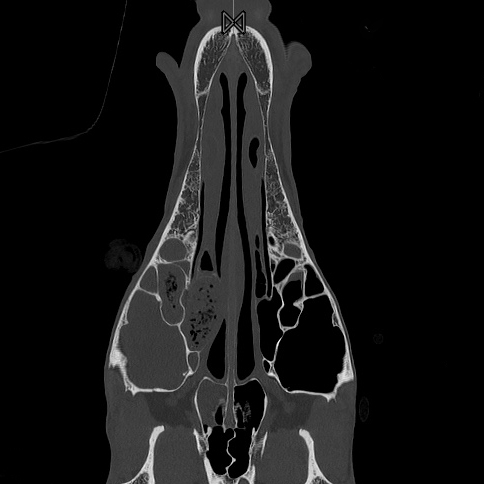
To make the diagnosis, we perform an endoscopy of the upper airways and nasal passages. X-rays of the head help to show any fluid lines in the sinuses. A thorough examination of the oral cavity serves to identify a diseased tooth that fits the symptoms, and X-rays of the tooth roots are taken as well. The best diagnostic method, however, is computed tomography (CT), which provides a complete, minimally invasive scan of the whole head. It shows the tooth roots clearly so they can be assessed, which is especially helpful when the oral examination shows no or only minimal findings.


In sinusitis of dental origin, the diseased tooth must first be treated or extracted to remove the cause of the inflammation. Depending on the extent of the inflammation and how much the sinuses are filled, trephination (opening of the sinuses) followed by thorough lavage may be necessary. Sinus surgery is performed on the standing horse under light sedation and local anesthesia.
Accompanying treatment includes antibiotics, anti-inflammatory drugs and mucolytics. Aftercare of the tooth socket is an important part of therapy.
If the cause of the inflammation has been removed and the sinuses have been thoroughly flushed and treated, the prognosis for full recovery is good.
Depending on how the extraction goes and how long the sedation lasts, we often use the same sedation for both procedures, always with the horse’s welfare in mind. In some cases, the procedures need to be done in two separate sessions.
Yes. For horse and owner, it is usually best if the horse is admitted for a few days (usually 3–5 days) for the sinus lavage. This allows us to monitor the horse around the clock and check feed intake and manure output. The sinuses are flushed once a day until all inflammatory material has drained. The horse can go home once the lavage catheter has been removed, which also keeps the risk of infection as low as possible.
As with cheek tooth extraction, it is a good idea to check with your insurer before the procedure whether the costs will be covered. As a rule, these costs are covered by surgical insurance.
We kindly ask you to schedule appointments by phone. This way, we can plan the best treatment for your horse individually and directly.
+49 4282 - 5946340Please note our separate visiting hours.
Please book your visit in advance. Allow about one hour, and please only touch your own horse.
Our clinic is available around the clock for emergencies.In case of an emergency, please call us immediately.

We kindly ask you to schedule appointments by phone. This way, we can plan the best treatment for your horse individually and directly.
+49 4282 - 5946 340Please note our separate visiting hours.
Please book your visit in advance. Allow about one hour, and please only touch your own horse.
Our clinic is available around the clock for emergencies.In case of an emergency, please call us immediately.